ZENtheRapper 02/18/25
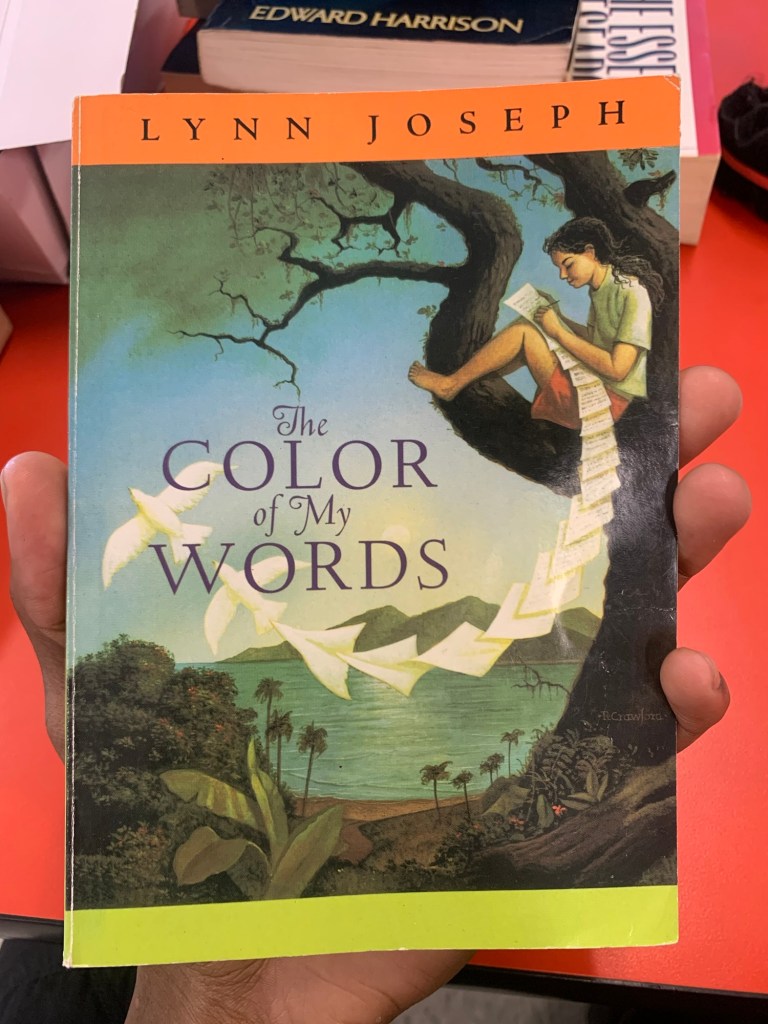
Reading: The Color of My Words by Lynn Joseph, Published in 2000.
From Book’s Epigraph: Sometimes you have no control over what will happen next, as I discovered the year I was twelve years old – but sometimes you do, that’s when it is time to take charge because you sure don’t know when the chance will come again.
“But there were plenty of words swirling around and around in my head and although I couldn’t see what they were, I saw only a haze of color, and the color of my words was red.”
–
ZENtheRapper 02/18/25
This children’s book by Lynn Joseph is a great introduction to imagery in language, as well as an excellent encouragement and inspiration for young writers who may be wondering where their words can take them.
In it, the main character – Ana Rosa – is a twelve-year old Dominican girl who is maturing into her identity as a writer, during a time when her skills are much needed in her community. She writes poems and beautiful stories, using her words to paint culturally specific images, from her favorite vantage point in this Gri Gri tree overlooking her village. In the words of young Ana Rosa:
The Gri Gri Tree:
I like to sit high
In my gri gri tree
Where I can survey
All below me.
On top of the gri gri
I’m a strong, dark queen
Sitting on a throne
of towering green.
I hold the leaves close
As the wind blows past.
I kiss the rain drops
As the thunder blasts.
I’m the gri gri queen
And I’m in command
Protecting my tree
From careless hands.
Alone with a treasure
No one else sees.
Hidden from the world
And all who seek me.
You see, for Ana Rosa, writing is a special gift – her special way of relating to the world. She spends her time filling notebooks with thoughts, poems, and stories. She is encouraged by her older brother to become a political writer who speaks truth to power. By her mother, she is encouraged to become a creative writer, one that pens beautiful stories and lovely poems.
With her capabilities, she could do either… or both, really.
In the text, the government authorities on this island issue a notice that everyone in Ana Rosa’s community will need to be relocated, because their land and property were bought up from underneath them. By some evil developers, or something.
In response, Ana Rosa’s brave brother emerges as a leader for his community, organizing folks, and helping them articulate their civil rights to the state intruders. The action builds to a familiar trope, whose familiarity fails to take away from the emotional effect of the scene. During a community rebellion against developers, Ana Rosa’s brave brother – Guario – died as a martyr protecting the land of his people, more specifically – protecting the gri gri tree that his sister so valued as her place to write.
While the bulldozer inched closer to her brother, Ana Rosa found herself paralyzed by fear, too scared to even scream out in defiance. All she could do was watch from her perch up in that gri gri tree, a familiar location that all of a sudden began to take on totally new meaning.
Ultimately, after some mourning (and after swearing off writing forever) she uses her brother’s martyrdom as motivational fire. She resolves to write the story of her brave brother’s life and sacrifice, with the typewriter she receives for her 13th birthday – a gift that was initiated by her brother just a few days before he passed.
During this time of grief, of mourning, of processing things, Ana Rosa saw the color of her words as red. What is the color of your words, usually? Are your words a passionate red, or a softer pink? Are they a mystical purple, or a magisterial brown? Are they a cheery yellow, or a shiny, reflective gold?
It’s something to think about. I’m sure most of us have a wide palette that we pull from for different writing activities, but which word-color might you be remembered for?
One last thing – the gri gri tree. A former Urbana Poet Laureate gave me some advice sometime last year, when I was telling her about my aspirations as a writer. She told me to make sure, in this wild and wonderful, high-stimulus world we live – to make sure that I found a place to write. A place that was special to me, where I could find sanctuary, and where my perspective could be clearly articulated from. Where do you think I write from these days? What do you think my special writing place is like? What’s yours like?
This is a great book to give to a young writer in your life. The best part is that on each page, it highlights idioms and pieces of figurative text and explains their meaning at the bottom of the page, helping students connect the fun of figurative language with their skillful and adroit usage. What is the color of your words?
ZENtheRapper ☀️♾️
 ZEN Gardens
Leave a comment